
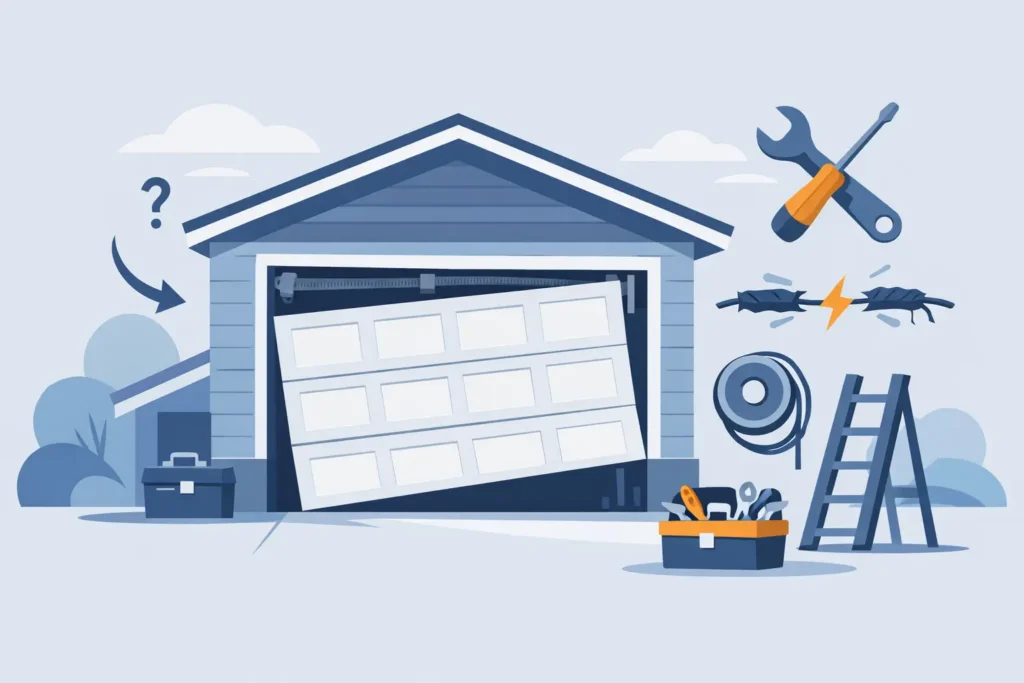
A garage door that starts rising evenly but ends up tilted, drags against one side of the opening, or hangs lower at one corner is not just an appearance issue. If you are asking, “why is my garage door crooked,” the door’s lifting system is usually out of balance or a component has shifted, worn out, or failed. Continuing to run it can turn a manageable repair into a damaged door, broken opener, or safety hazard.
A crooked garage door needs attention quickly, especially if it is stuck halfway, making grinding noises, or has a loose cable visible near the drum. Stop using the opener, keep people and vehicles clear of the door, and avoid trying to force it level by hand.
Why Is My Garage Door Crooked? The Most Common Causes
Garage doors are designed to move as one balanced unit. Springs carry most of the door’s weight, cables lift each side together, rollers guide the door through the tracks, and the opener provides controlled movement. When any of those parts stop doing their job, one side can move differently from the other.
A broken or slipped lift cable
A cable problem is one of the most common reasons a door becomes noticeably crooked. Each side of the door has a lift cable that winds around a drum above the opening. If one cable snaps, comes off the drum, or loses tension, that side of the door will not lift correctly.
You may see one corner hanging lower, a cable that is loose or wrapped unevenly near the top of the door, or a door that rises a few feet and jams. Do not pull on the cable or attempt to rewind it yourself. Garage door cables work under high tension, particularly when they are connected to loaded springs. The right repair may involve resetting the cable, correcting the drum position, and checking the entire spring system for the original cause.
A broken garage door spring
A broken torsion spring can leave the door heavy, uneven, or unable to open at all. In some cases, a spring may not be completely broken but may have lost tension or been installed incorrectly. Extension spring systems can also create uneven lifting when one spring fails or stretches more than the other.
Your opener may hum, strain, or move the door only a few inches because it is trying to lift weight that the springs should be carrying. A spring repair is not a DIY job. These parts store substantial force and require the correct tools, training, and replacement parts to service safely.
Bent tracks or damaged rollers
The tracks along both sides of your door must remain straight, aligned, and firmly attached to the framing. A vehicle bump, shifting hardware, worn rollers, or impact from a stored item can bend a track or push it out of alignment. Once a roller catches or leaves the track, one side of the door can lag behind the other.
Look for obvious gaps between rollers and track, rubbing marks on the door sections, loose brackets, or a track that appears bowed. Do not hammer the track back into place. A track that looks only slightly bent may still be misaligned enough to cause binding. Professional adjustment is usually faster and safer than replacing more parts later.
Loose or damaged hinges and door sections
Garage door hinges allow the panels to bend as they travel along the curved portion of the track. If a hinge breaks, loosens, or pulls away from a cracked door section, the door can bind and lift unevenly. This is more likely on older doors, doors exposed to repeated moisture, or commercial doors that see heavy daily use.
A damaged panel can also make the problem look worse than it is. A technician needs to determine whether the panel itself is repairable or whether weakened metal, wood, or composite material is affecting the door’s safe operation. Replacing a single section is sometimes possible, but it depends on the door model, age, color match, and availability.
An out-of-level door or shifted mounting hardware
Not every crooked door begins with the door itself. Settling around the garage opening, loose flag brackets, worn bearing plates, or improperly mounted tracks can affect how the system carries weight. Minnesota’s freeze-thaw cycles and normal home movement can expose weak mounting points over time.
This type of issue often develops gradually. The door may have worked with a slight shake or rubbing sound for months before it starts hanging lower on one side. Correcting it requires more than tightening a few visible bolts. The tracks, header hardware, springs, cables, rollers, and door balance all need to be checked together.
What to Do When Your Garage Door Is Hanging Crooked
The safest first step is simple: stop operating the door. Pressing the opener repeatedly can strip gears, bend the top section, pull rollers out of the track, or cause the door to drop farther on the failed side.
If the door is partly open, do not walk beneath it and do not try to disconnect the opener unless the door has been secured by a trained technician. A crooked door can shift suddenly, even if it seems stable. Keep children, pets, and vehicles away from the opening until the problem is assessed.
You can safely make a visual check from a distance. Note whether a cable is loose, whether a spring has a visible gap, whether a roller has come out of the track, and whether the door was hit recently. Those details help a repair technician arrive prepared. Avoid loosening brackets, winding springs, moving cables, or removing track hardware. No shortcut is worth the risk of a falling door or a tension-related injury.
Can You Use the Opener With a Crooked Door?
No. The opener is not designed to correct a door that is out of balance. It is designed to guide a properly functioning, spring-balanced door. When one side binds or drops, the opener has to fight against uneven weight and friction. That can damage the motor, chain or belt, rail, trolley, and the door itself.
Some modern openers stop and reverse when they sense unusual resistance, but that safety feature does not protect every part of the system. A door can still twist, a cable can become tangled, or a roller can tear through a damaged track before the opener shuts down. If the door is crooked, treat it as a mechanical repair first and an opener issue second.
How a Professional Diagnoses the Problem
A proper garage door repair starts with securing the door so it cannot move unexpectedly. The technician then checks cable routing and drum position, spring condition and tension, track alignment, roller wear, hinges, brackets, bearings, and the door’s overall balance.
The repair may be straightforward, such as replacing worn rollers and realigning a track. It may also involve cable replacement, spring replacement, new hinges, reinforcement of a damaged section, or adjustment of mounting hardware. The correct solution depends on why the door became crooked in the first place. Resetting a cable without addressing a worn roller, bent track, or failing spring can leave you with the same problem again.
For homeowners and property managers, upfront diagnosis matters. You should know what failed, why it failed, what parts are needed, and what the repair will cost before work begins. That is the difference between a lasting repair and a temporary adjustment.
When a Crooked Garage Door Is an Emergency
Call for urgent service if the door is stuck open, hanging at an angle, has a snapped cable, has come off the track, or will not secure your home or business. The same applies if a vehicle is trapped inside or the door protects tools, inventory, or access to a commercial property.
A door that is only slightly uneven but still closes may not require a middle-of-the-night repair, but it should not be ignored. Schedule service soon before the problem worsens. BOS Garage Door Repair provides same-day and emergency garage door service across the Twin Cities, with in-house technicians, honest upfront pricing, and no subcontractors.
A crooked garage door is your warning that the lifting system is no longer working as designed. Leave it closed if you can, stop using the opener, and have the door inspected before a small alignment issue becomes a full system failure.